
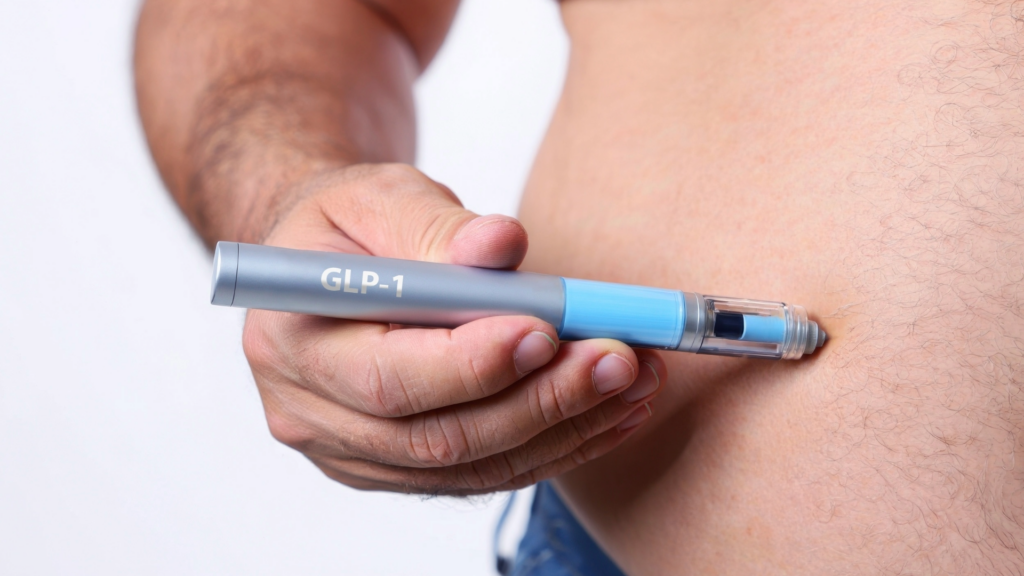
The Medicare GLP-1 Bridge Program is a temporary program from the Centers for Medicare & Medicaid Services (CMS) that allows eligible Medicare Part D beneficiaries to access certain weight-loss GLP-1 drugs for $50 per month from July 1, 2026 through December 31, 2027.
It operates outside of Medicare Part D, meaning plans do not process claims or bear any risk. The program only covers GLP-1 medications that the FDA approves for weight loss, and beneficiaries must meet BMI and prior authorization requirements.
What are the key takeaways of the GLP-1 Program?
- The Medicare GLP-1 Bridge Program starts July 1, 2026
- The program is temporary and ends December 31, 2027
- Offers select weight-loss GLP-1 drugs for $50/month
- Operates outside of Medicare Part D, but requires you to have a Part D plan
- Requires BMI + health conditions + prior authorization
- Future access depends on the implementation of the upcoming BALANCE Model
- The program excludes some GLP-1 medications, like Ozempic.
What Is the Medicare GLP-1 Bridge Program?
The Medicare GLP-1 Bridge Program is a temporary program created by the Centers for Medicare & Medicaid Services. It is a short-term program that gives Medicare Part D beneficiaries access to certain GLP-1 weight-loss drugs that Medicare normally does not cover. Since 2003, Medicare Part D has legally prohibited coverage for drugs prescribed solely for weight loss.
Medicare implemented the Bridge Program after delaying the BALANCE Model, which would provide similar access to GLP-1 weight-loss drugs through participating Part D plans. The GLP-1 Bridge Program operates outside of Medicare Part D plans.
How Does the Bridge Program Work?
CMS directly handles processing, approval, and implementation of the GLP-1 Bridge Program.
- The government negotiates lower GLP-1 rates directly with drug companies.
- A doctor must certify a Medicare beneficiary meets the BMI and conditions requirement.
- Doctor requests prior authorization directly from CMS, not the Part D plan.
- CMS processed and approves or denies the prior authorization.
- If approved, the beneficiary pays $50 per month for approved GLP-1 medication starting July 2026.
- The Bridge Program does not go through the Part D plan and has no effect on the Part D maximum out-of-pocket costs.
The Medicare GLP-1 Bridge Program operates and processes directly through CMS. CMS negotiated GLP-1 weight-loss drug prices with manufacturers to offer eligible Medicare beneficiaries a flat $50 monthly copay. Only beneficiaries enrolled in a Medicare Part D plan can access the program. However, even though Part D plan enrollment is a requirement, the Bridge Program operates outside of Part D. This means that any copay amounts paid through the program do not count toward your Part D deductibles or maximum out-of-pocket.
If you already hit the catastrophic phase of your Part D plan, you still have a $50 per month copay for GLP-1 prescriptions through the Bridge Program. You must first get prior authorization through your doctor to participate. Your doctor will certify directly with CMS, verifying that you meet all CMS health requirements to participate
Who Qualifies for the GLP-1 Bridge Program?
To qualify for the GLP-1 Bridge Program, you must be enrolled in a Part D plan and meet one of three BMI (Body Mass Index) and health condition tiers. Specific Bridge Program requirements are below. See below about BMI caclulations.
1. Enrolled in a Medicare Part D Plan. This can be a standalone Part D plan or a Medicare Advantage with Part D coverage.
2. A doctor must certify that you meet one of the qualifying eligibility tiers.
- Tier 1: A BMI of 35 or higher (no other qualifying conditions)
- Tier 2: A BMI of 30 or higher AND one of the following qualifying conditions: Heart failure (preserved ejection fraction), Uncontrolled hypertension (despite 2+ medications), Chronic kidney disease (Stage 3a or higher)
- Tier 3: A BMI of 27 or higher AND one of the following qualifying conditions: Pre-diabetes, Prior heart attack, Prior stroke, Peripheral artery disease
3. You are not already taking the GLP-1 for another qualifying condition covered by your Part D plan.
4. Doctors prescribe GLP-1 medications alongside ongoing lifestyle changes, including structured nutrition and physical activity.
* The program calculates BMI based on when you first started using a GLP-1 medication for weight-loss management, not when the Bridge Program begins. For example, if you started GLP-1 therapy in 2025 with a body mass index (BMI) of 37, but your BMI drops to 34 by the time your doctor submits a prior authorization request in July 2026, your provider should confirm that you met the BMI 35 or higher requirement when treatment began.
Which GLP-1 Brands Are Covered Under the Bridge Program?
The GLP-1 Bridge Program only includes GLP-1 medications that the FDA specifically approves for weight loss.
Drugs approved for weight loss include:
- Wegovy (injection and oral)
- Zepbound (KwikPen only)
- Foundayo (as listed in program guidance)
Drugs that are NOT approved for weight loss:
Ozempic and Mounjaro are not covered under the Bridge Program because the FDA approved them for diabetes treatment, not weight loss.
What happens when the GLP-1 Bridge Program expires?
After the Bridge program ends in December 2027, CMS will replace it with the BALANCE Model. The Balance Model will be slightly different than the Bridge Program, but will still provide access to GLP-1 for weight loss.
The BALANCE Model (Better Approaches to Lifestyle and Nutrition for Comprehensive hEalth) is a Centers for Medicare & Medicaid Services (CMS) initiative that CMS originally planned to launch in 2026. The program aims to expand access to GLP-1 medications and healthy lifestyle interventions for people enrolled in Medicare. However, CMS delayed the program after fewer Part D carriers participated than expected. The Bridge Program is a temporary solution until BALANCE Model starts.
How Will the BALANCE Model Work?
With the Balance model, the program moves inside Part D, with the Part D plan administering it. Not every Part D plan will participate in the Bride Program. Only plans that opt in can process and give access to GLP-1 for weight loss. Therefore, you must choose a Part D plan that participates in the BALANCE Model to continue GLP-1 coverage for weight loss. Right now, fewer Part D plans have opted in than anticipated, citing the funding needed to implement it and the uncertainty of how many people will participate.
Since the BALANCE Model will operate inside Part D, it will count toward your deductible and maximum out-of-pockets. The deductible phase would be limited to $245 for a 30-day supply. The coverage phase costs would depend on the plan; $50 for enhanced plans and $125 for basic plans. Plan sponsors could choose to apply lower cost-sharing if they do so uniformly across all model drugs.
How does the BALANCE Model differ from the Bridge Program?
- BALANCE Model operates inside Part D plans
- Participation is optional for Part D plan. Not all plans will offer it!
- Requires you enroll in a plan that participates
- Copays will be $50 or $125 depending on the Part D plan (Basic or Enhanced, respectively)
- Copay WILL count toward Part D maximums,
- Health condition requirements vary for qualification tiers.
It will be more important than ever to review your Part D plan before BALANCE Model starts. This means you should meet with a licensed agent during the Annual Enrollment Period (10/15 to 12/7). A licensed agent can help you identify which plans will offer the BALANCE Model.
Bridge Program vs BALANCE Model
| Feature | Bridge Program | BALANCE Model |
| Timeline | 2026–2027 | 2028 – 2031 (tentative start) |
| Runs through | CMS directly | Part D plans |
| Plan participation | Not required | Required |
| Cost structure | Flat $50 | Plan-dependent |
| Count towards deductible/ Maximum out-of-pocket | No | Yes |
FREQUENTLY ASKED QUESTIONS ABOUT THE BRIDGE PROGRAM
The program begins July 1, 2026 and is scheduled to end December 31, 2027.
At this time, Wegovy (injection & Oral), Zepbound® (KwikPen only) and Foundayo are approved for the GLP-1 Bridge program.
Ozempic and Mounjaro current have FDA approval for diabetes. The program only includes GLP-1 with FDA approval for weight loss.
You must visit your doctor to get prior authorization first. Your doctor sends in the prior authorization to CMS to certify you meet the health and BMI requirements.
Yes. You must have either:
– A standalone Medicare Part D prescription drug plan, or
– A Medicare Advantage plan with Part D drug coverage
Eligible beneficiaries will pay a flat $50 per month for approved GLP-1 medications through the program.
The Bridge Program is expected to transition into the CMS BALANCE Model after December 31, 2027.

Hi, My name is Butterfly. I have been licensed, contracted and certified to assist with Medicare for over 10 years. I specialized in educating the public about Medicare enrollment rules, timelines, and coverage options. My goals is to help you understand your options and help you avoid common enrollment mistakes that can lead to penalties or gaps in coverage.

My bmi is 28 but I have heart failure my EF is 45. Can I get on the bridge program
Hi Elizabeth, The program includes heart failure in Tier 2, but you should still visit your doctor to find out and try for prior authorization just in case. They start accepting prior authorization requests after July 1st.
I am sure that BMI is 34.
How can I get on this program, very interesting
Hi Roberta! You just need to visit your doctor who handles your care, and they submit the prior authorization to CMS directly. So speak with your doctor about it.
Which GLP1 providers are working with the Bridge program?
Hi Bill, Any doctor that manages your care can submit the prior authorization to CMS for approval. There isn’t a network of doctors for the bridge program or anything, you just need a doctor to submit to CMS verifying your qualifications.
I don’t understand how one day you can be on it and the next day you can’t. I have Medicare & Medicaid. My BMI was at 32 so now I have to get it online if I want it. Why can’t I continue to be on it? I’ve lost 14lbs and now they are saying screw you. You don’t qualify for either.
Hi Heather,
Are you saying your Prescription plan stopped approving your prescription? Did you just become eligible for Medicare, or have you been on Medicare the whole time? Sometimes when you become newly eligible for Medicare and already had Medicaid, then once you get Medicare your Medicaid no longer pays for prescriptions because those costs shift to Medicare. I am not familiar with your situation to say why they kicked you off though. Did you have it through the GLP-1 Bridge program, or was it prescribed for a health condition other than weight management by your doctor?
Hello. My Mom has a BMI of 37 and CKD Stage 4 so she would qualify under Tier 2. Her CKD is manageable and she will not need Dialysis as long as her eGFR does not go down. Her Nephrologist recently recommended she use Ozempic but the price is far outside of her monthly budget ($620+). The Pharmacist mentioned the Bridge program and prior authorization from the Nephrologist. The Nephrologist believes my Mom will do well on Wegovy, but she now says that she will not complete the prior authorization process with the CMS because she does not believe my Mom qualifies with a BMI of 37 and Stage 4 CKD. The Nephrologist stated CKD needs to be stage 3a or above which is what I have seen on all of the Bridge and Medicare websites. Stage 4 is above (higher) than 3a, so my Mom should meet the eligibility requirements, right? I have advised her to message the Nephrologist and explain that there seems to be a misunderstanding in what the term (above) means in this respect, and if the Nephrologist will submit the prior authorization and let the CMS verify and approve or deny. Is my understanding that Stage 4 is above (higher) than 3a and would qualify under Tier 2?
Hi Michael, If her BMI is 37 then she would qualify as Tier 1 regardless of any other qualifying conditions. To qualify for Tier one, you just need a BMI of 35 or higher. No need to verify a qualifying condition at that tier. She could just go to her primary care physician and request they send in the prior authorization. It does not have to come from her Nephrologist if the Nephrologist gives you a hard time. I hope this helps! If you need any other help with her Medicare plan, then let us know! We are happy to help her review her options.
where should my doctor send prior authorization for zepbound to
what is CMS and would the doctor have that information
Hi Jamie… CMS is Centers for Medicare & Medicaid Services. This is where the prior authorization request is sent. You doctor will have this information to send it. They request it on your behalf.
My BMI was over 36 about 5 yrs ago. I have lost some weight since then, and now my BMI is about 33. Would Medicare qualify me with my higher BMI or would it only accept my current BMI?
My BMI is over 30. I have controlled hypertension (have been taking medication for 30 years), I am prediabetic, insulin resistant and have recently been diagnosed with severe OSA. I do have a Part D plan. Can I get on the bridge program if my doc submits a PA directly to CMS with my Tier 3 qualifying conditions? (BMI + prediabetes).
Hi Dianne! Based on the program tiers, you would qualify with BMI over 30 and pre-diabetes. However, are you already taking a GLP-1 for a condition and it is covered by your Part D plan? If you are already taking any of the GLP-1 drugs for anything and your plan is covering it, then they will not approve you for the GLP-1 program. If you are not taking GLP-1 that is covered by your Part D plan, then you should see your doctor and ask them to submit to the GLP-1 program for pre-authorization.
I am on Mounjaro for Diabetes. I am paying $601 for the first month’s perscription. Then it goes down to $270 per month . Is there anything I can do to make this more affordable. I’m retired and the only income I have is social security
Hi Holly,
As far at the GLP-1 bridge program, they won’t qualify you since you are already taking Mounjaro for another ailment and it is covered under your Part D. However, there may be other ways to reduce what you are paying, depending on where you live or how much your income is each month. All Part D plans cover certain prescriptions at different tiers/ prices on their formularies. Are you on a standalone Part D or Medicare Advantage with Part D coverage included? There could be a different Part D plan in your area that has lower copays for Mounjaro. some Medicare Advantage plans tend to cover it for a lower copay. Chronic Special Needs plans can have a lower copay as well since you have Diabetes.
As far as your income, if it is below $1995 a month (as a single person), then you could get assistance to keep your copays much lower. You can call our office and we can help you determine if there are plans in your area with a lower copay. 480-821-9188. Anyone that answers can help you! Just mention we answered your question on the site so they know.